Artificial intelligence is no longer a futuristic concept — it’s the engine quietly running behind recommendation feeds, hospital diagnostics, fraud detection systems, and virtual assistants. For a generation of BCA students entering the job market, this shift isn’t just a trend to watch; it’s a career runway waiting to be used.
A BCA degree already builds the programming logic, problem-solving mindset, and computer science fundamentals that AI careers are built on. What separates a BCA graduate who lands an AI role from one who doesn’t usually comes down to the extra layer of skills, tools, and hands-on projects added on top of the degree.
This guide breaks down exactly what that extra layer looks like — the skills to prioritize, the projects worth building, and where BCA graduates typically end up once they specialize in AI.
Why AI Is a Natural Next Step for BCA Graduates
AI adoption has moved past the experimental phase. Banks use it for credit risk scoring, retailers use it for demand forecasting, hospitals use it for diagnostic support, and nearly every software product now ships with some form of intelligent automation baked in.
That widespread adoption has created a hiring gap: far more companies want AI capability than there are professionals who can build it. For BCA students, this gap is an opportunity — the degree already covers programming fundamentals, data structures, and software development concepts that form the backbone of any AI role. What’s needed on top is targeted skill-building in mathematics, machine learning, and applied data work.
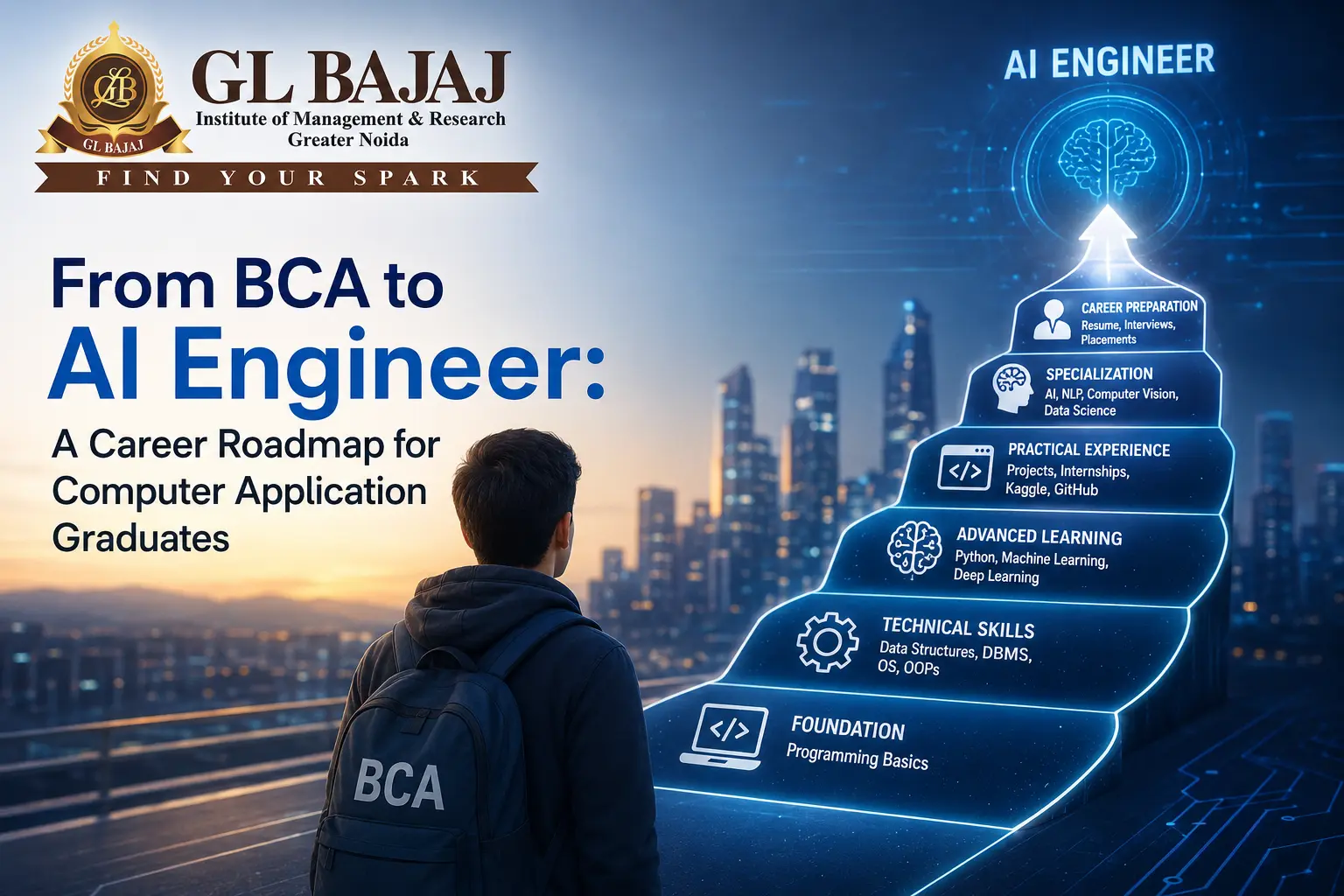
The Skill Stack: What to Learn Beyond the BCA Syllabus
1. Python, seriously Most AI tooling — from scikit-learn to TensorFlow to PyTorch — is built around Python. Go beyond basic syntax and get comfortable with functions, object-oriented programming, and file handling, since these form the backbone of real AI scripts and pipelines.
2. The math you can’t skip Linear algebra, probability, statistics, and calculus aren’t academic formalities here — they explain why machine learning models behave the way they do. Understanding gradients, distributions, and matrix operations makes debugging models far less confusing later on.
3. Machine learning fundamentals This is where systems start learning patterns from data instead of following fixed rules. Start with supervised learning (classification, regression) before moving into unsupervised techniques like clustering.
4. Deep learning Neural networks power the technology behind facial recognition, self-driving systems, and voice assistants. It’s a more advanced layer on top of machine learning, but it’s increasingly a baseline expectation for AI-focused roles.
5. Data analysis and SQL AI models are only as good as the data feeding them. Learning to clean messy datasets, query databases with SQL, and visualize trends is unglamorous work — but it’s what most entry-level AI jobs actually look like day to day.
Build Something: Projects That Actually Matter
Certificates help, but projects prove you can apply what you’ve learned. A few worth putting on a resume:
- A chatbot that handles basic customer queries
- A face detection or recognition system
- An automated resume screening tool
- A fake news or misinformation classifier
- An image classification model
- A spam email filter
- A movie or product recommendation engine
Each of these forces you to work through the full pipeline — collecting data, cleaning it, training a model, and evaluating results — which is exactly what employers want to see evidence of.
Where This Leads: Career Paths After BCA + AI Skills
Once the skill stack and a project portfolio are in place, BCA graduates typically move toward roles like:
- AI Engineer
- Machine Learning Engineer
- Data Scientist
- Data Analyst
- Robotics Engineer
- AI Research Assistant
- Business Intelligence Analyst
- AI Software Developer
- Prompt Engineer
Some of these — like Prompt Engineer — didn’t exist as job titles a few years ago, which says a lot about how fast this field keeps generating new career tracks.
What’s Coming Next in AI
The field isn’t slowing down. Generative AI, large language models, autonomous AI agents, and responsible/ethical AI frameworks are all actively reshaping how companies hire and what skills they prioritize. Staying relevant means treating learning as ongoing rather than a one-time certification — the tools that matter in two years may look different from the ones in demand today.
Choosing the Right Foundation
Not every BCA program is built with AI in mind. When evaluating colleges, look for programs with an updated curriculum that reflects current industry tools, faculty who actively teach applied machine learning (not just theory), and supplementary sessions or workshops focused specifically on emerging technologies like AI. A strong foundation here makes the self-driven learning that follows significantly easier.
Final Thoughts
A BCA degree gives you the starting toolkit — programming logic, software fundamentals, and structured problem-solving. AI careers are built by layering targeted skills, real projects, and consistent learning on top of that base. Students who start early, build a portfolio, and stay current with the field’s fast pace put themselves in a strong position for some of the most in-demand tech roles available today.
FAQs
Can a BCA graduate realistically break into AI without a separate CS or data science degree?
Yes. A BCA already provides the programming and computer science foundation needed. Adding Python proficiency, machine learning knowledge, and a portfolio of applied projects is generally enough to qualify for entry-level AI and data roles.
Which projects carry the most weight on a resume?
Projects that demonstrate the full pipeline — data collection, cleaning, model training, and evaluation — tend to stand out most. Chatbots, recommendation systems, and classification models (spam, fake news, image) are strong, well-understood starting points.
What skills should be prioritized first?
Python and foundational math (statistics and linear algebra) come first, since nearly every other AI skill builds on them. Machine learning fundamentals should follow, with deep learning and specialized tools added once the basics are solid.